

Outsourced Bookkeeping for Accountants: The Real Build vs. Buy Decision for Growing CPA Firms



According to a recent survey, 83% of financial leaders say they are struggling to find qualified accounting talent. That statistic alone helps explain why a growing number of CPA firms are rethinking a decision that once seemed straightforward: how and where to build their bookkeeping capacity.
As the accounting talent pool becomes increasingly competitive, every hiring decision carries greater financial and operational weight. Open positions can remain unfilled for months; compensation expectations continue to rise, and the true cost of replacing an employee often extends far beyond salary alone. Meanwhile, client expectations do not pause.
That reality has pushed many managing partners and owner-CPAs toward a broader strategic dilemma. Should they continue expanding their bookkeeping teams in-house or consider outsourced bookkeeping for accountants?
This guide explores both models, helping CPA firms evaluate the true costs, operational trade-offs, scalability, technology capabilities, and long-term implications of choosing between in-house and outsourced bookkeeping services.
Here is where the comparison begins.
The True Cost of In-House Bookkeeping Apart From Salary Numbers
Ask most managing partners what an in-house bookkeeper costs, and the answer is often one word: salary.
The problem is that salary is only a visible portion of the equation. The median pay for bookkeeping, accounting, and auditing clerks sits close to $49,000 a year. On a budget spreadsheet, that number can feel manageable. But once you layer in payroll taxes, health benefits, retirement contributions, paid leave, workstation, software licenses, and ongoing training, the fully loaded cost of one in-house bookkeeper can regularly reach $3,000 to $5,000 a month beyond salary.
And then comes the expense most CPA firms underestimate: turnover.
In today's accounting labor market, turnover is not an exception. It is a planning consideration.
Open roles can stay unfilled for months, and that scarcity gives bookkeeping staff more leverage to leave for a better offer. A firm carrying a $55,000 bookkeeper who resigns mid-tax season is not just short-staffed. It could also face a five-figure hidden cost on top of the hiring search itself. For a closer look at the real cost of a vacant bookkeeper role, consider what happens when that position stays open.
And the visible salary cost is only part of the picture. The infographic below shows what can sink the budget beneath the surface.
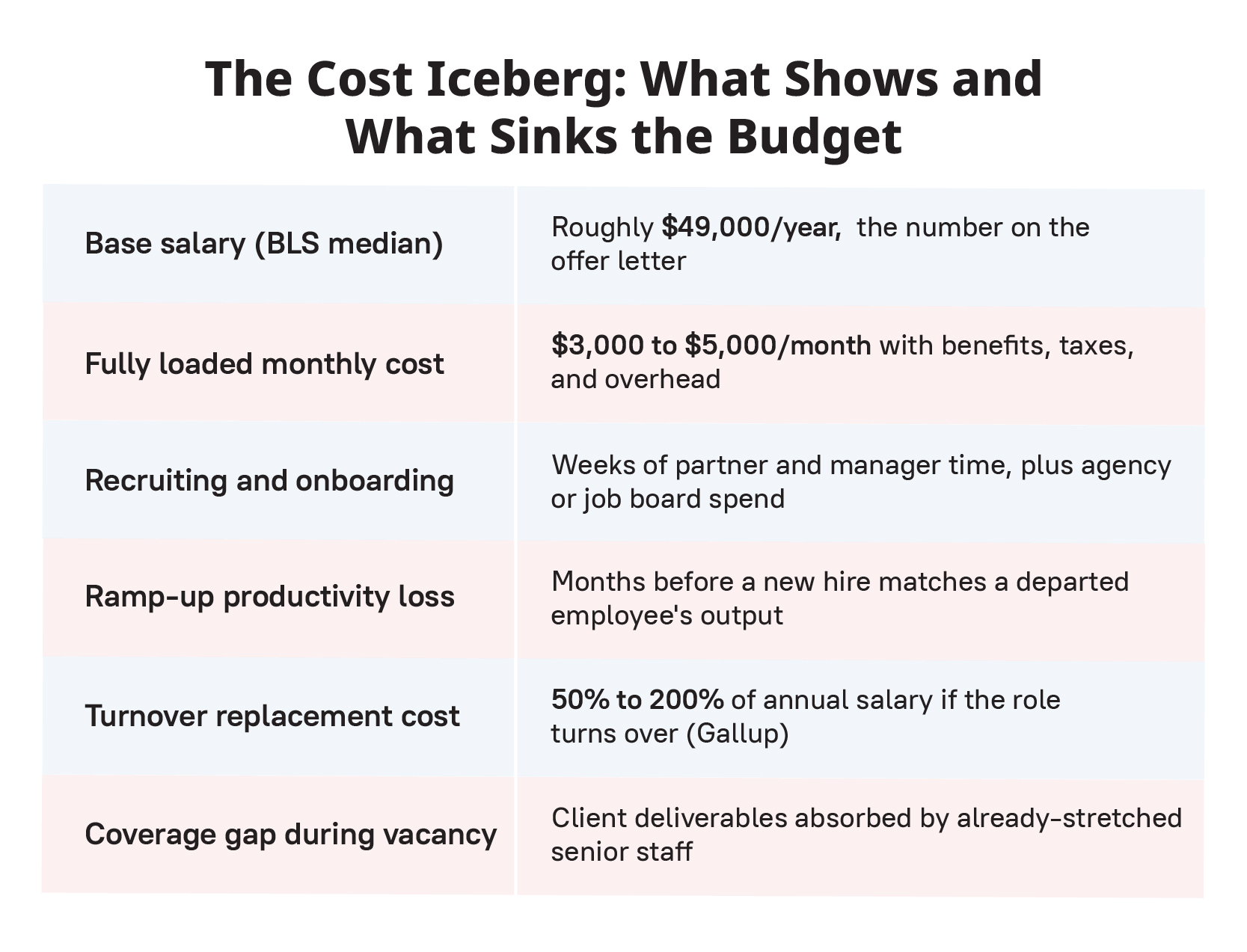
None of this means an in-house hire is a bad decision. For some firms, having a bookkeeper physically present, embedded in daily client conversations, is worth the premium. What it does mean is that the comparison should never start with a salary line. It should start with the fully loaded number, plus the real odds that the role turns over inside a labor market this tight.
What Changes Day to Day With Outsourced Bookkeeping for Accountants
Once you understand the true cost of maintaining internal capacity, the conversation naturally shifts to the alternative. That is where concerns about visibility and control begin to surface.
Firms considering outsourced bookkeeping for accountants often imagine losing visibility into their own client files. In a properly run engagement, that fear does not hold up against how the workflow is actually structured. The work itself gets done on the firm's chart of accounts, inside the firm's existing software stack, and on a schedule the firm sets.
What changes is who is doing the repetitive, transactional layer of the work.
In practical terms, CPA firms typically gain:
- Dedicated bookkeeping capacity
- Consistent month-end processing
- Backup coverage during absences
- Standardized workflows
- Faster reconciliation turnaround
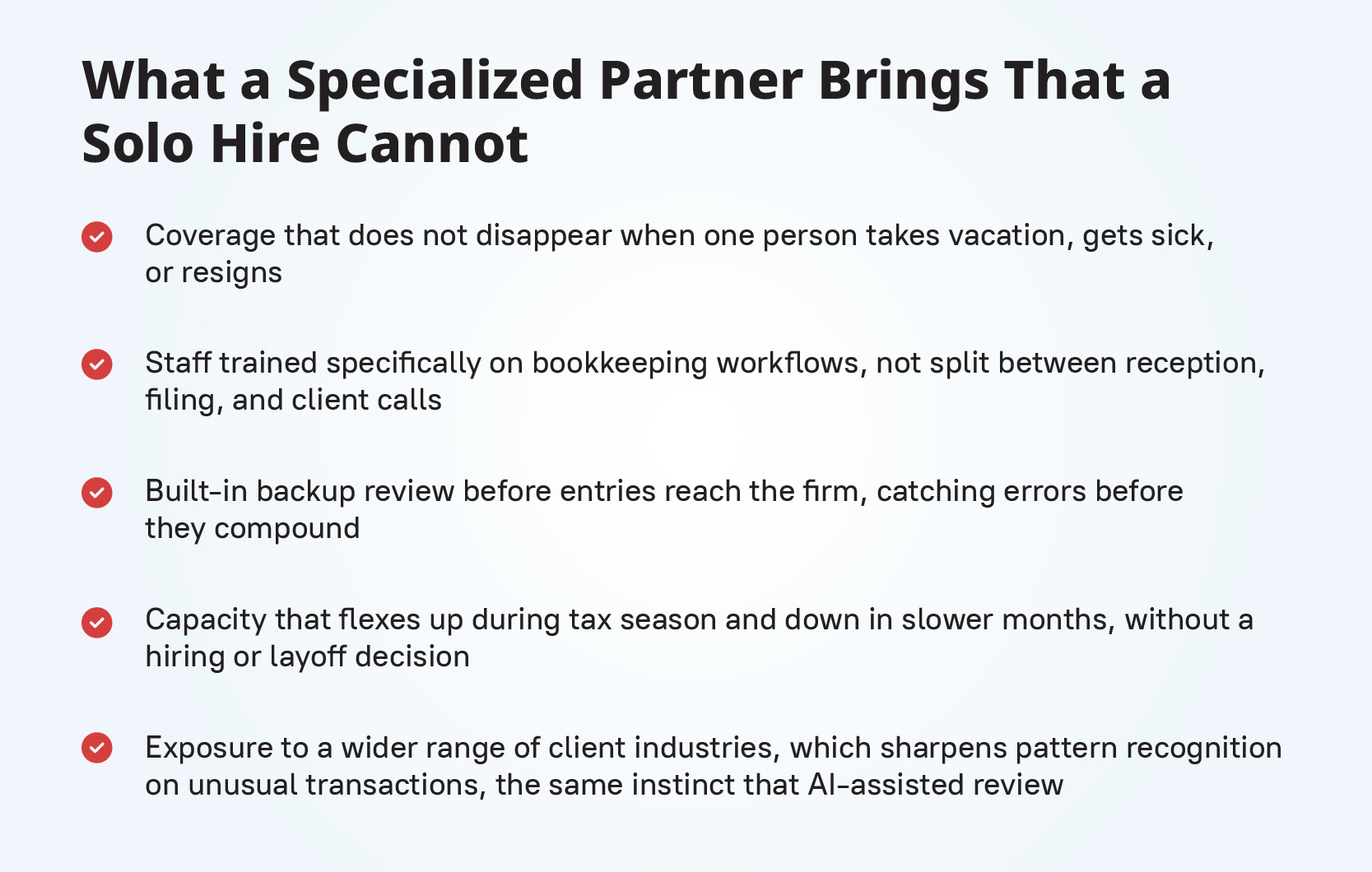
Instead of one generalist handling every client's books alongside phone calls, filing, and ad hoc requests, a dedicated team of specialists processes the volume. That specialization tends to show up as fewer miscategorized transactions and faster turnaround on reconciliations, simply because the people doing the work are not context switching between five unrelated tasks in a single afternoon.
Communication shifts too, though not in the direction firms often expect.
- Defined point of contact: Outsourced bookkeeping services typically establish a clear point of contact and documented escalation path, so firms are not dependent on one person who happens to be on vacation or out sick.
- Consistent coverage: If a question comes up about a client’s transaction history, someone is available to address it because the workflow does not depend on a single employee’s availability.
- Client relationships stay where they belong: Clients continue working directly with their engagement partner or manager. The back-office processing remains behind the scenes, much like a firm’s cloud hosting provider or payroll processor.
What clients notice is whether their financials are accurate and on time, not who keyed the entries.
Quality and Oversight: What Stays Firmly in the Partner’s Hands
One of the most common concerns around a bookkeeping outsourcing model is whether that reduces visibility or oversight. It is a reasonable question. Managing partners have spent years building client relationships, and establishing trust in the firm's processes, so extending part of bookkeeping function to an external team can feel unfamiliar at first. That concern deserves a direct answer, and it sits at the center of most conversations about outsourced bookkeeping for accountants weighing this decision.
Control stays with your firm
In practice, review authority, final sign-off, and every judgement call that requires professional expertise remains with the firm itself. The outsourced team handles defined bookkeeping activities, while licensed professionals continue to oversee the work, review outputs, and make client-facing decisions. The objective is not to replace the firm’s control but to create additional capacity within it.
Your data stays protected
Security is often the next concern. The more useful question is not whether client data sits outside office, since modern cloud accounting platforms already operate that way. The better question is how access is controlled, monitored, and protected. A reputable provider should clearly document its security practices before any work begins. That documentation should outline user access permissions, confidentiality requirements, audit trails, encryption standards, and procedures for handling sensitive financial information. For firms evaluating their broader security posture, these considerations closely align with many of the best practices discussed in the guide to cybersecurity for CPA firms.
Accuracy and speed can improve
Partners frequently worry that speed and accuracy will decline when bookkeeping moves outside the firm. In many cases, the opposite happens. A dedicated team focused on recurring transactional work can develop a deeper familiarity with client accounts, reporting patterns, and reconciliation requirements over time.
The conversation no longer ends with oversight alone. As bookkeeping workflows become increasingly digital, firms are placing greater emphasis on the technology capabilities behind efficient growth.
The Technology Gap Many CPA Firms Underestimate
When firms think about bookkeeping capacity, they often focus on people. But today, technology plays just as important a role.
Modern bookkeeping is no longer just about recording transactions and reconciling accounts. Firms are also expected to work faster, deliver better visibility, handle larger workloads, and improve efficiency. That often requires the right systems, automation, and workflows behind the scenes.
The challenge is that being a great bookkeeper does not automatically mean being an expert in accounting technology. Setting up new tools, improving workflows, integrating systems, and finding practical ways to use AI requires a different set of skills.
As technology continues to shape how accounting work gets done, many firms discover that the real challenge is not only finding qualified people. It is also building the technology capabilities needed to support growth.
An Often Overlooked Benefit of Outsourced Bookkeeping
One benefit many firms overlook is that outsourced bookkeeping can provide access to both talent and technology. Many outsourced providers already operate within technology-enabled environments. Instead of building every capability internally, firms can often gain access to:
- Workflow automation that reduces repetitive manual work
- AI-assisted processes that improve efficiency and turnaround times
- Standardized workflows that create greater consistency across engagements
- Reporting tools and dashboards that improve visibility into client data
- Technology expertise to support system adoption and workflow improvements
- Established security and operational processes that support reliable service delivery
Because these capabilities are already in place, firms can often benefit from them without the time, cost, and effort required to build everything from scratch. That shifts the conversation beyond staffing alone. Instead of asking, "How do we hire more people?" firms can also ask, "Do we want to invest time and resources building these capabilities ourselves, or leverage a model where they already exist?"
As firms evaluate their long-term capacity strategy, understanding the financial implications of each approach becomes equally important.
True Investment Snapshot: In-House vs Outsourced Bookkeeping
The decision involves more than salary or monthly service fee. A more useful comparison looks at the full cost of maintaining the function, including benefits, technology, training, coverage, and the risk of turnover or capacity gaps. The snapshot below puts the two models' side by side so CPA firms can see where the costs and trade-offs actually fall.
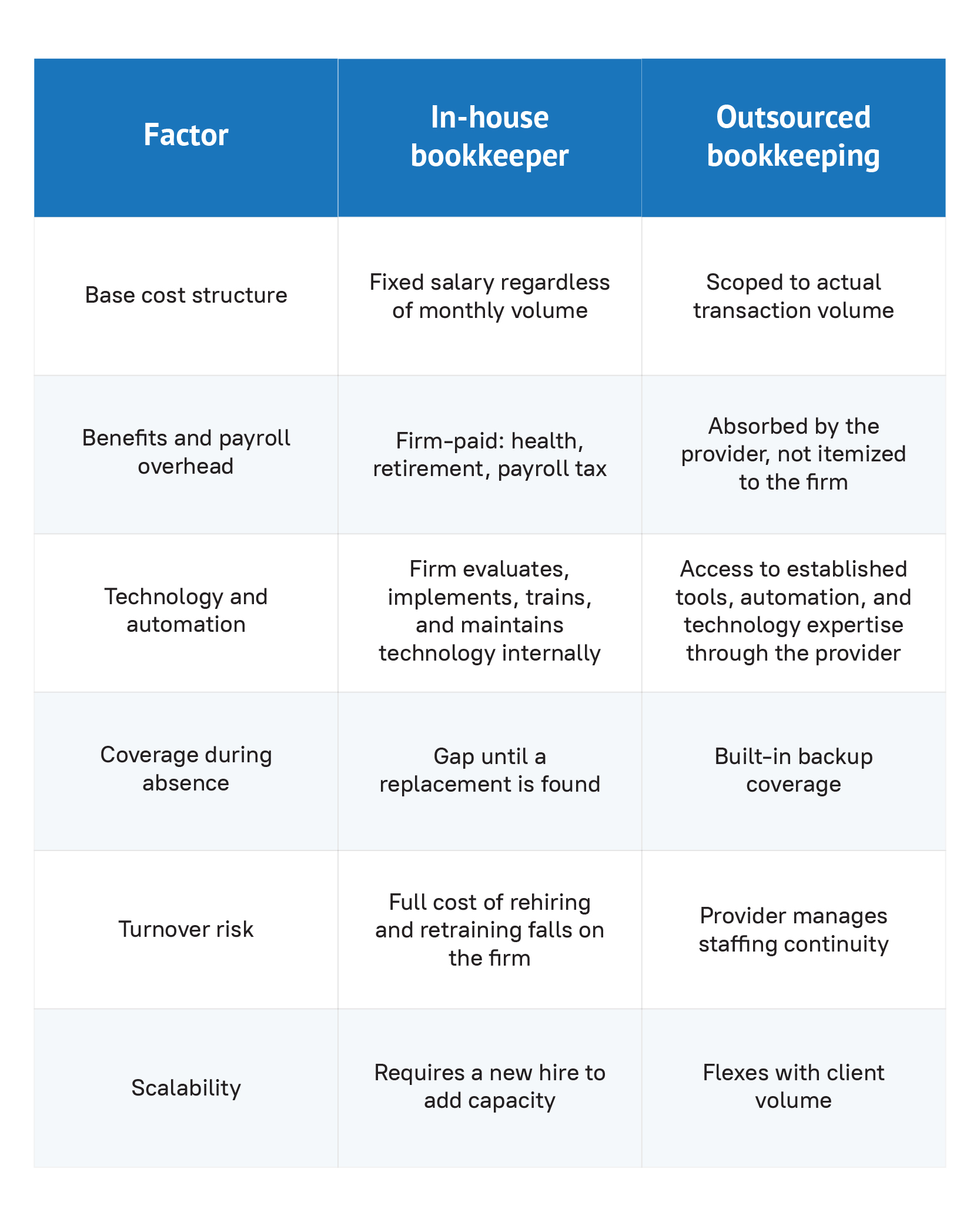
Firms that compare both options objectively often find that the difference is not as clear-cut as it first appears. Outsourcing is not always cheaper, and keeping the work in-house is not always less risky. Cost matters, but it is rarely the only factor that decides the choice.
How to Decide Which Bookkeeping Model Actually Fits Your CPA Firm
There is no universal right answer between in-house vs outsourced bookkeeping for accountants. The right fit depends on firm-specific volume, growth, and bandwidth rather than a one-size-fits-all formula. What follows is a set of practical questions a partner group can work through together.
1) Start with volume and seasonality
A CPA firm with steady, predictable transaction volume year-round has a stronger case for an in-house hire as the workload can justify a dedicated full-time role. But a firm whose volume spikes around tax season and slows during the rest of the year may end up paying full-time costs for a part-time need. That is where specialized support can make a difference. Especially when a firm is growing and its back office is struggling to keep up. If that sounds familiar, these five signs are worth a closer look.
2) Look honestly at your growth trajectory
A CPA firm adding new clients every quarter can outgrow one bookkeeper faster than expected. At that point, the choice becomes hiring again, retraining again, and absorbing turnover risk again, or scaling a relationship that can already flex with volume. Firms in a genuine growth phase may find a bookkeeping outsourcing model easier to scale than a hiring pipeline competing in a historically tight accounting labor market. That talent shortage remains one of the top challenges CPA firms faces today.
3) Then weigh your internal bandwidth
Managing a bookkeeping employee, reviewing their work, covering absences, and handling performance conversations all take partner or manager time. That time has an opportunity cost, especially when billable advisory work is being pushed aside. An outsourced relationship shifts much of that management burden to the provider, freeing senior staff to focus on the work that actually grows the firm. That includes client advisory, tax strategy, and relationship building.
These questions can help clarify which model fits your firm. But the answer does not always have to be one or the other.
The Hybrid Path: Outsourcing Alongside an Existing Team
The framing of in-house against outsourced suggests a CPA firm must pick one and abandon the other. In practice, most growing firms land somewhere in between, and that middle ground can often be the strongest option available. An existing in-house employee does not need to be let go for outsourced bookkeeping for accountants to add value.
The two can work in tandem, with internal staff focused on client-facing review, advisory conversations, and judgment calls that require a CPA's expertise. While a specialized outsourced team can absorb the transactional work that takes up hours without requiring a license to perform.
A well-structured approach can address these concerns while giving the firm more flexibility:
- Keep control where it matters: Internal staff can retain full review authority and oversight, while the outsourced team handles the day-to-day bookkeeping workload.
- Make costs more predictable: A clearly scoped engagement can be priced around actual transaction volume, making costs easier to plan and reducing the uncertainty of an open-ended workload.
- Build security into the process: Data security does not have to mean giving up control. Access controls, confidentiality terms, and defined workflows can be established before the engagement begins, following the same cybersecurity practices CPA firms are adopting worldwide.
- Reduce dependence on one person: If accuracy or speed becomes a concern, the work is supported by professionals trained specifically for bookkeeping rather than relying on one generalist wearing multiple hats, a shift accelerating as AI reshapes accounting and CPA firm workflows.
The accounting outsourcing market has grown for exactly this reason. The global finance and accounting business process outsourcing market reached an estimated $70 billion in 2025 and is projected to keep expanding at close to a 9% annual growth rate through the early 2030s, according to Grand View Research. .
That growth is driven by firms building a bookkeeping outsourcing model that lets internal staff focus on the advisory work clients value most. While using external teams, technology, and automation to manage recurring transactional volume more efficiently.
And once a firm looks at the options this way, the decision becomes less about choosing one model and more about choosing the right mix for where the firm is today and where it wants to go next.
Making the Call
The decision between in-house vs outsourced bookkeeping should never rest on which option sounds better in a partner meeting. It should rest on the fully loaded cost of an internal hire and the real turnover risk in a constrained labor market. It should also consider coverage gaps and how much senior bandwidth the firm can afford to spend managing transactional work instead of advising clients.
In-house bookkeeping may make more sense for CPA firms with steady, predictable volume. If your firm has enough consistent work to support a full-time bookkeeper and has the capacity to manage and train that employee, an in-house hire can make sense. It can also be the right choice if having someone dedicated to the team is a priority.
Outsourced bookkeeping may make more sense for lean, seasonal, or growing firms. If workload fluctuates, hiring is difficult, or the firm is adding clients faster than it can build an internal team, outsourced bookkeeping services can provide additional capacity. This can help the firm handle more work without adding another full-time role to the payroll.
A combination can work well for CPA firms that need both control and flexibility. Internal staff can retain oversight, client-facing review, and higher-value advisory work, while an outsourced team handles recurring transactional volume.
Frequently Asked Questions
Will outsourced bookkeeping work for a firm our size?
It usually does, since the engagement scales with client volume rather than firm headcount. A five-person firm can start with a single scoped engagement covering a handful of clients, while a fifty-person firm can hand off an entire transactional workload. The model expands or contracts with the work in front of it, not the other way around.
What happens to our current in-house bookkeeper if we bring on outsourced support?
Nothing has to happen to that role at all. Most firms keep their in-house bookkeeper or accountant in place and shift that person toward review, client-facing work, or higher-value tasks, while the outsourced team absorbs overflow or routine transactional volume. The two roles typically split the work rather than compete for it.
How is our client data protected once outsourced bookkeeping is added to our workflow?
A properly structured engagement documents access controls, encryption standards, and confidentiality terms in writing before a single file changes hands. The work happens inside the firm's existing software and chart of accounts, giving the firm full visibility into the bookkeeping process. Firms should ask for these details in specific, checkable terms rather than a general promise of "security."
Do we lose sign-off authority over the books?
No. Final review and sign-off stay with the firm's licensed staff in a properly structured engagement. The outsourced team handles the transactional layer, including entries, reconciliations, and month-end processing. The firm retains responsibility for review, professional judgment, and all decisions that require accounting expertise.
How long does onboarding take before outsourced bookkeeping is fully running?
Most firms start with a small pilot, often five to ten clients, before expanding the engagement further. A pilot typically moves from kickoff to production work within a few weeks, giving the firm a chance to evaluate accuracy, communication, and turnaround time before committing to a larger roster.
Do we need to tell clients we are using an outsourced bookkeeping team?
Many firms choose not to, since the back-office work is invisible to the client in the same way a payroll processor or cloud hosting provider is invisible. Firms that prefer full transparency can fold it into normal client communication, the same way they already keep clients updated on accounting and tax law changes. Either approach works, as long as the firm stays consistent with what it tells clients.
Does outsourcing give CPA firms access to better technology?
Often, yes. Many providers invest in accounting technology, automation platforms, reporting tools, workflow systems, and AI-enabled processes across multiple clients. This can give firms access to capabilities that may be expensive or difficult to build and maintain internally.
Can outsourced bookkeeping help our firm adopt AI?
Yes. Providers that have already invested in automation and AI-enabled workflows can help firms benefit from those capabilities without needing to evaluate, implement, and manage every technology initiative on their own. The value comes from both the tools and the experience required to use them effectively.


.svg)
.svg)