


According to an article in the Journal of Accountancy, do-it-yourself (DIY) automation tools have helped non-programmers connect and share data between multiple software applications. Accounting automation is no longer dependent on developers connecting applications with APIs. However, multiple factors influence efficient financial management and not all of these can be addressed by software alone:
- The need for accuracy and reliability is crucial in a startup business looking to expedite growth.
- Business owners must dedicate time to accounting operations even with software in place.
- Accounting provides financial reporting and analysis to indicate financial health, including liquidity and available cash.
- Financial statements are used to make informed business decisions.
Here are five considerations that startup and small businesses should research for DIY accounting software to manage financials:
#1: Additional reviews of automated processes
Software automates repetitive manual bookkeeping and accounting tasks. However, any software generated report must undergo diligent in-person reviews to confirm the information is correct.
#2: Financial management needs beyond the accounting software
Accounting software must be customized to help deliver what is required and relevant to the business. Relevant metrics are established after thoroughly assessing the business and reviewing goals, clientele, and industry of operations. Businesses integrating DIY accounting software must have trained, dedicated staff to implement, establish operations, and build reporting. For startups and small businesses, this usually falls to the owners who are often stretched too thin to invest the time needed.
#3: Basic infrastructure needs of software to deliver results
For optimum performance, most software requires a basic infrastructure, including computer configurations that match the software requirements. Without the requisite infrastructure, it doesn’t make sense to of install the software. For startups and small businesses struggling with liquidity, investing in infrastructure is an insurmountable capital expense.
#4: Periodic re-alignment needs of software configuration
Software can be customized to help businesses with tax-time operations, by providing correct data and processing. Tax schedules and calculations depend on multiple factors, including business structure, number of employees, wage composition, and insurance. Periodic upgrades are also necessary to ensure software is working optimally.
#5: Lack of technical support
One of the challenges of DIY accounting is the lack of timely technical support. Businesses must have real-time access to software expertise to manage repairs and breakdowns. This is especially true during peak demand season such as tax filings and auditing. For startup and small businesses, waiting for technical support expends valuable time that can be allocated to other activities. In the absence of someone dedicated to the software application, day-to-day aspects of business bookkeeping and accounting may be neglected.
Partnering with financial management to leverage expertise
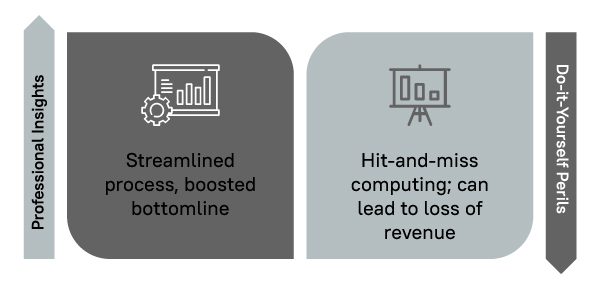
Determining the right software solution for your business is critical to optimizing automation. Professionals can help review existing systems and align them with business goals to outline and achieve effective software solutions. Any new software needs to be integrated effectively within the existing systems, tested for efficiency and issues, and finally, set up for regular upgrading and maintenance. This is an ongoing cycle, and one which needs time, resources, and liquidity on the part of the business.
Partnering with trained outsourcing providers can help business owners effectively address their automation needs. Outsourcing also enables access to accounting expertise and high-caliber infrastructure, without the need for expensive capital investments. This addresses the need for cost efficiency and reliable business operations faced by startups and small to mid-sized businesses.
Next Steps
- Learn more about how professional CFO support services and customized accounting and bookkeeping can help businesses streamline business processes and financial management.
- Email us at sales@analytix.com or call us on 781.503.9002 today.
- Follow our blog for industry trends and the latest updates.
- Engage with us on LinkedIn and Twitter.


.svg)
.svg)